
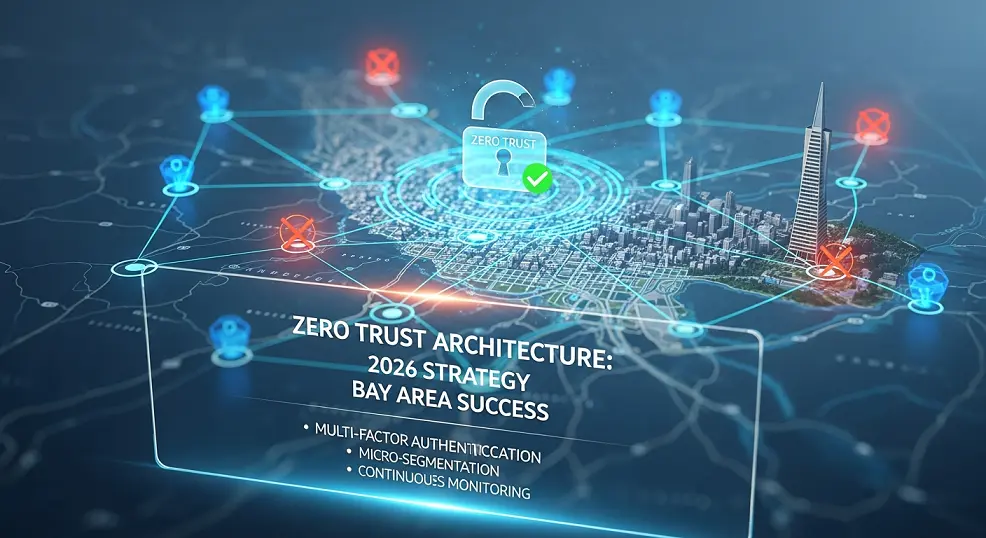
The “perimeter” is dead. In a world of remote teams in Palo Alto, cloud-native apps in San Mateo, and AI agents in Fremont, your security can no longer rely on a single firewall.
Zero Trust Architecture (ZTA) is built on one simple, unwavering principle: Never trust, always verify. Every user, device, and connection must be authenticated and authorized continuously, regardless of whether they are sitting in your San Jose office or a coffee shop in Burlingame.
As of January 1, 2026, the updated CCPA (California Consumer Privacy Act) mandates that businesses performing “high-risk” data processing must undergo annual cybersecurity audits. ZTA isn’t just a security choice; it’s your strongest defense against regulatory fines and the rising tide of AI-driven deepfake attacks.
To successfully implement ZTA, Fiji IT Solutions focuses on five core pillars that transform your security from a wall into a dynamic, intelligent fabric.
Identity is the new perimeter. We replace simple passwords with phishing-resistant MFA (Multi-Factor Authentication) and biometric “passkeys.” Every login attempt is evaluated based on:
User Identity: Is this actually your employee?
Behavioral Context: Is it normal for them to access financial data at 3 AM from Newark?
In 2026, a “valid password” isn’t enough. Our systems check the posture of the device. If an employee’s laptop in Redwood City is missing a critical security patch or has its firewall disabled, the Zero Trust gate stays closed until the device is compliant.
Traditional networks are “flat”—once a hacker is in, they can move anywhere. Zero Trust uses micro-segmentation to create “secure islands.” If your marketing team’s software in Hayward is compromised, the attacker cannot “jump” to your accounting servers in Menlo Park
We move your business away from aging VPNs to Zero Trust Network Access (ZTNA). Instead of giving a remote worker access to your entire network, ZTNA gives them access only to the specific application they need to do their job.
Data is the “crown jewel.” In compliance with the latest California laws, we ensure all sensitive personal information (PI) is encrypted at rest and in transit, with automated logging to prove compliance during your annual audit.
Implementing Zero Trust can be complex, but as your local Bay Area MSP, we handle the heavy lifting. We serve as your fractional vCIO, guiding you through a phased rollout that won’t disrupt your daily operations.
The Visibility Audit: We map your data flows across all cities—from your headquarters in San Francisco to your satellite offices in Milpitas and Union City.
Identity & MFA Modernization: We deploy a unified Identity Provider (IdP) so your team has one secure login for everything.
Continuous Monitoring: Our 24/7 Security Operations Center (SOC) watches your Zero Trust environment, using AI to detect and block anomalies in real-time.
The businesses that thrive in 2026 are those that treat security as a competitive advantage. By implementing Zero Trust with Fiji IT Solutions, you aren’t just “checking a box” for compliance—you are building a resilient, scalable foundation for growth.
Ready to future-proof your business? Whether you’re in Mountain View, Los Altos, or San Jose, let’s build your Zero Trust roadmap today.
Fill out the form below, and we will be in touch shortly.